European Union (EU) says it is currently in talks with the Zambian Government on a potential Sustainable Investment Facilitation Agreement to attract, expand and retain foreign direct investments (FDIs) in the country.
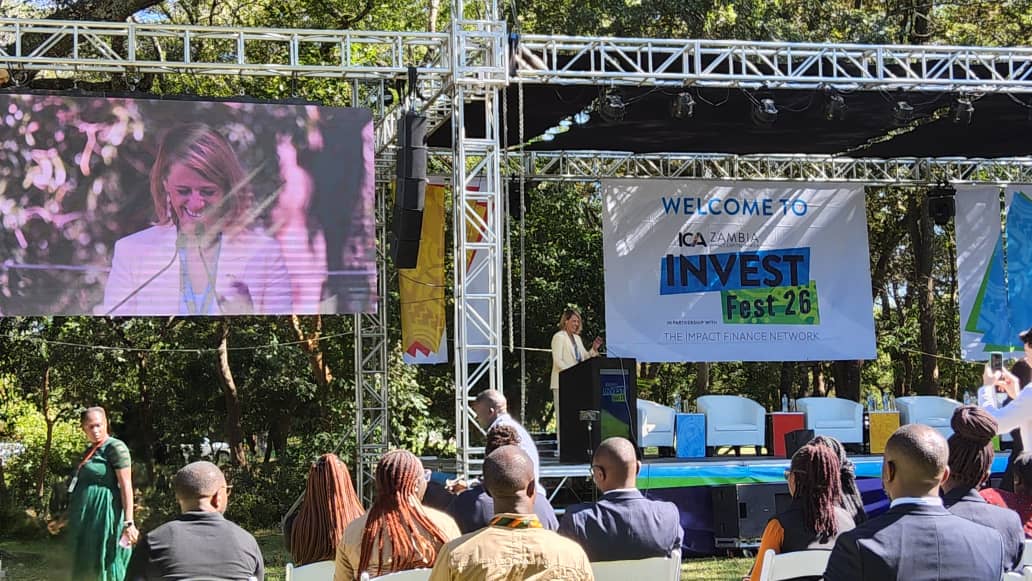
EU Ambassador to Zambia and COMESA Karolina Stasiak, said on the other hand, the EU is working with European financing institutions to derisk and facilitate investment.
“The EU remains a stable, reliable and predictable partner for Zambia. Our recipe is clear: we provide support based on a mutually beneficial partnership. In a 360° approach we support the government in addressing systemic issues in key sectors of the economy, while also promoting social, environmental and governance aspects, strengthening of oversight institutions and accountability mechanisms,” she said.
Speaking at the Impact Capital Africa (ICA) Zambia InvestFest 2026 in Lusaka, Ms. Stasiak stated that Zambia has been appreciated as a peaceful and stable country, open for business engagement and promoting democratic values.
“Together with targeted reforms and political will to address the bottlenecks, these are key competitive advantages that can make the country stand out as an attractive investment destination,” Ms. Stasiak stated.
“A business environment with predictable regulatory framework, procedures that are simple and quick in facilitating investment, the rule of law and the good international reputation are key elements that investors are looking for.”
Speaking at the Impact Capital Africa (ICA) Zambia InvestFest 2026 in Lusaka, Stasiak, however, expressed disappointment over the cancellation of a major international digital rights event that could have enhanced Zambia’s global standing.
“We really regret that the RightsCon – a major global convention on digital rights scheduled to take place in Lusaka this week was cancelled at the last minute – it was an opportunity to support Zambia’s image as an open country with visitors from over 150 countries, including major tech companies,” Ms. Stasiak stressed.
On private sector growth, the EU envoy underscored the importance of unlocking capital for small and medium-sized enterprises (SMEs), describing them as central to Zambia’s economic transformation.
“ICA brings together all the right ingredients to ensure that conversations translate into commitments and concrete investments: ambitious entrepreneurs, experienced investors, financial institutions, cooperating partners and public authorities.”
She emphasized that the EU’s Global Gateway strategy prioritizes private sector-led investment. “We know that public finance alone will not be sufficient to fund the needs of sustainable development,” she remarked.
“Therefore, our offer of partnership for Africa is based on bringing in the private sector to drive the investment in innovation and infrastructure to improve connectivity, inclusive and sustainable economic growth based on local value addition.”
Ms. Stasiak highlighted the growing role of impact investment in delivering both financial returns and measurable social outcomes.
“This is particularly important in the current context of geopolitical uncertainty, and instability that leads to economic pressure and fragility of value chains. It’s a time that forces us to look for new solutions and for partnerships that promote stability, resilience and opportunity. And there are great opportunities for Africa and for Zambia,” she said.
She pointed to concrete results from EU-supported initiatives, particularly in agriculture and agribusiness. “Through the Enterprise Zambia Challenge Fund, we partnered with Zambian SMEs in agriculture, aquaculture and agribusiness,” she said. “With this support, more than 3,000 jobs were created and over EUR 40 million was paid directly to small-scale farmers for their produce.”
The EU is also supporting Zambia’s transition to a green and circular economy through the GREENTech4CE programme.