By Cecilia Chiluba
A pre-election assessment mission deployed to Zambia by the National Democratic Institute (NDI) has raised concerns over ongoing constitutional and electoral reforms, warning that late changes could undermine transparency and voter confidence ahead of the August 13, 2026 general elections.
In its report findings following a visit from April 25 to 30, the delegation noted that key amendments to the Electoral Process Act were initiated starting in late 2025, limiting the time available to fully consider the implications of reforms, operationalize changes, and undertake needed voter education.
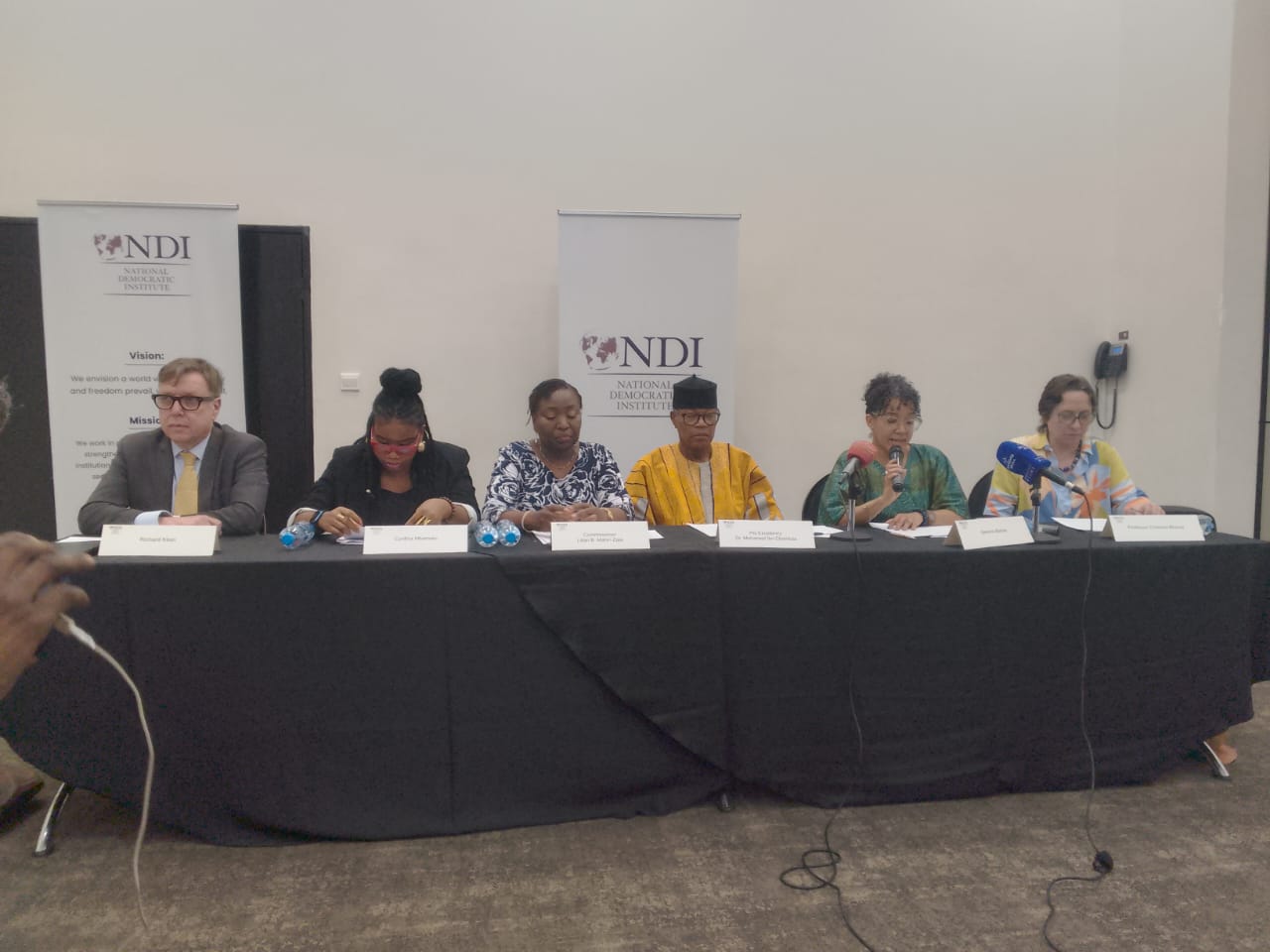
Head of delegation, Mohamed Ibn Chambas, former Deputy Minister of Foreign Affairs of Ghana, African Union High Representative for Silencing the Guns, and Chairman of the African Union High-Level Panel on Sudan, told Journalists at a media briefing in Lusaka that international best practice is for changes to the electoral system to be finalized a year before an election to avoid such challenges.
He noted that thirty-five years since the country’s return to multiparty democracy, the Zambian populace is unwavering in its commitment to democratic principles,” he stated. “The 2026 general elections are a significant milestone and will test Zambia’s ability to consolidate the democratic gains from the 2021 general elections.”
Dr. Mohammed expressed concern over provisions in the proposed law requiring political parties to submit lists of candidates for proportional representation (PR) seats only after election results are announced. “This limits the ability of voters to make informed choices and for the Electoral Commission of Zambia (ECZ) to ensure candidates meet nomination requirements,” he said.
While the introduction of a mixed-member proportional representation (MMPR) system was welcomed, the mission said there was insufficient clarity on how the system will be implemented, particularly regarding allocation of seats and voter understanding of the new framework.
The delegation also flagged potential imbalances in constituency representation, noting that the distribution of the 70 new National Assembly constituencies does not meaningfully address longstanding inequalities of voting power, adding that the average vote in parliamentary elections in non-Lusaka provinces is worth more than twice the average vote from Lusaka province.
According to Dr. Mohammed, Zambians further expressed concerns about limited political space, the lack of tolerance for divergent views, and the inability of all political parties and candidates to freely contest elections.
“As with past elections, the arbitrary application of the colonial-era Public Order Act (POA) remains a key concern, as it continues to stifle political activities and undermine a level playing field. A Public Gathering Bill to replace the POA was introduced while the delegation undertook its work, which could address these concerns,” he said.
NDI Regional Director for Southern and East Africa, Gemima Barlow, said while many aspects of the 2026 general elections are already set, with just over 100 days until Zambians cast their ballots, there is still a window of opportunity for Zambians to take meaningful steps to demonstrate their desire for participatory, transparent, and accountable election.
In its recommendations, the delegation called on all political actors in Zambia to ensure a free, fair, and inclusive electoral process ahead of the August polls.
Former Vice Chairperson, Independent Electoral and Boundaries Commission (IEBC), Kenya, Commissioner Lilian B. Mahiri-Zaja, urged Zambian authorities to allow opposition parties to participate freely and fully in the electoral process in accordance with human rights standards, emphasizing the need to uphold freedoms of expression and assembly.
Commissioner Mahiri-Zaja, added that decisions on eligibility of candidates should seek to ensure that all eligible individuals are allowed to stand for election, stressing that mechanisms must be in place to correct administrative or technical challenges during nominations.
She further called for equal enforcement of the Public Order Act, noting that police must act impartially and consistently for all parties to enable vibrant political competition.
On electoral management, the mission encouraged the ECZ to demonstrate independence through transparent actions, including timely sharing of information and regular consultations with stakeholders
It also recommended that the ECZ make key electoral data—such as the voters’ register, polling station lists, and results—readily accessible. The delegation further called for reforms to streamline accreditation procedures for election observers, warning against overly restrictive processes that could undermine transparency.
“The delegation recognizes that it is the Zambian people who will ultimately determine the conduct and credibility of their own elections,” Commissioner Mahiri-Zaja, said.
The mission stressed that credible elections require transparency, inclusivity, and adequate time for reforms to be understood and implemented.’
The high-level delegation visited Zambia from April 25 to 30 to demonstrate the international community’s support for credible elections; to provide an independent and impartial assessment of pre-election processes and the overall electoral context; and to offer practical and constructive recommendations based on internationally accepted best practices for more participatory, transparent, and accountable elections.
Over the past 40 years, NDI has conducted more than 250 international election observation missions in 70 countries worldwide.