
A Climate-Smart Agriculture Expert, has cautioned that the recent lifting of maize export restrictions may not benefit smallholder farmers if deliberate measures are not taken to ensure their full participation in the emerging export framework.
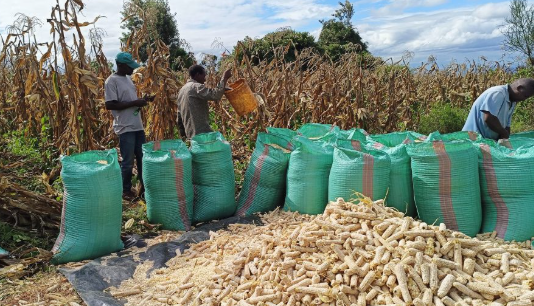
Recently, the government lifted the ban on maize and mealie meal exports, allowing traders and farmers to sell to regional and international markets.
Dr. Oliver Bulaya observed that a critical gap exists in limited awareness and access to timely, practical information among smallholder farmers.
“Without targeted intervention, many farmers risk being excluded from the benefits of a liberalized market due to information asymmetry and low market readiness,” Dr. Bulaya stated.
He emphasized the urgent need for government to strengthen agricultural extension service delivery and intensify stakeholder engagement to ensure smallholder farmers clearly understand the implications of this policy change.
“Communication efforts must go beyond general awareness and provide actionable guidance on key areas such as market access, pricing dynamics, quality standards, and cross-border trade procedures,” he emphasized.
Dr. Bulaya further stressed the need for the Ministry of Agriculture’s Marketing Department in close coordination with the Extension Services, to take a proactive leadership role in implementing a well-coordinated information dissemination strategy.
“Such an approach, he said, is essential to bridge existing knowledge gaps and empower farmers to participate meaningfully in export markets,” Dr. Bulaya said.
He warned that failure to act decisively could result in an uneven playing field, where large-scale producers and well-connected grain traders dominate export opportunities, leaving smallholder farmers vulnerable to exploitation and marginalization.
Dr. Bulaya called for the strengthening of farmer organizations, cooperatives, and aggregation models as inclusive platforms for market participation.
“These structures are critical for enhancing collective bargaining power, improving access to market intelligence, and reducing transaction costs associated with export trade,” he noted.
He further stressed the importance of Government clearly communicating operational modalities and implementation guidelines underpinning the policy.
“Transparency and clarity are vital to ensuring that all farmers—not just a select few—can access and benefit from the opportunities presented,” Dr. Bulaya stressed.
Dr. Bulaya added that while the lifting of maize export restrictions marks a progressive step towards market liberalization, its success will ultimately depend on inclusive and well-coordinated implementation.
“Strategic information dissemination, institutional alignment, and farmer empowerment will be key to ensuring that no smallholder farmer is left behind,” he added.