By Cecilia Chiluba
Efforts to deepen Zambia’s capital markets are increasingly shifting toward small and medium-sized enterprises (SMEs), as the Securities and Exchange Commission (SEC) rolls out targeted reforms aimed at improving access to long-term financing.
SMEs form the backbone of Zambia’s economy, yet many remain excluded from formal capital markets due to structural and operational constraints. These include limited financial records, informality, and the high cost of compliance associated with traditional listing requirements. In response, the SEC is repositioning the market to accommodate smaller businesses through an alternative listing platform and a broader support framework.
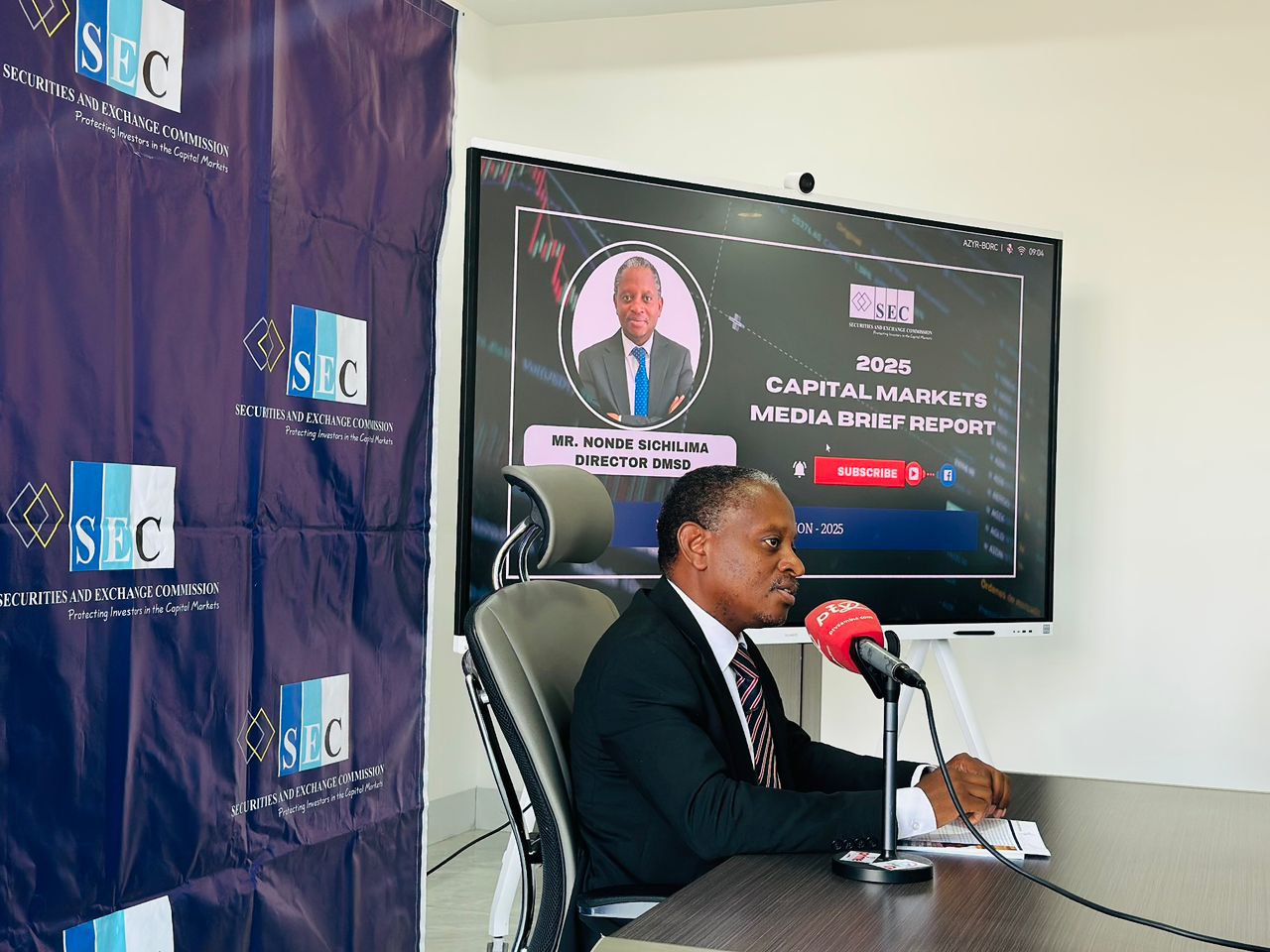
Speaking on the initiative, SEC Director-Market Development and Supervision, Nonde Shichima, acknowledged the long-standing barriers that have discouraged SME participation, particularly on the main board of the Lusaka Securities Exchange (LuSE).
Mr. Nonde said to address this, the Commission supported the creation of an alternative market tier designed specifically for SMEs, stating the alternative platform features less stringent listing requirements compared to the main board, without compromising its credibility or value to investors.
“This is a deliberate strategy to make it as easy as possible for SMEs to list on the market. The alternative tier is not inferior but tailored to meet SMEs where they are,” he explained.
Created by the Lusaka Securities Exchange (LuSE), the Alternative Market is positioned as a transitional platform, allowing SMEs to gradually integrate into formal capital markets while maintaining investor confidence. By easing entry conditions, the SEC aims to widen participation and enhance market inclusivity.
In 2025, Dot Com Zambia, made history by becoming the first small and medium-sized enterprise (SME) to list on the LuSE Alternative Market, marking a significant milestone in the development of Zambia’s capital markets.
The listing is expected to broaden access to financing for SMEs while enhancing market participation and investor confidence in the country’s financial sector.
To further incentivize uptake, the SEC has introduced cost-reduction measures, including a fee waiver targeting early adopters.
Mr. Nonde explained that among the key incentives is a fee waiver for the first 10 companies to list on the alternative market, easing concerns about high upfront costs.
“If an SME says I don not have enough money to list on this tier, there is an incentive for the first 10 companies that come on that tier, they will not pay any fees. There is also strategies such as getting the SMEs ready to list on the tier,” he stressed.
Beyond financial incentives, the Commission is addressing structural gaps that limit SME readiness. A significant proportion of SMEs operate informally, often without audited financial statements, clear governance structures, or bankable business plans—factors that are critical for attracting investment.
Mr. Nonde added that the Commission has rolled out business development services to help informal and semi-formal enterprises transition into investment-ready entities.
“A lot of SMEs in Zambia are highly informal, they operate without audited financial statements, they are not organized, they do not have business plans but they have the vision. So the Commission provides hands-on support, including assistance with preparing financial statements, organizing company structures, and developing investor-friendly proposals,” Mr. Nonde said.
A key component of this support system is the use of designated advisors, who guide SMEs through the technical and regulatory aspects of listing. This approach is intended to reduce the administrative burden on business owners while ensuring compliance with market standards.
Mr. Nonde stated that SMEs are assigned designated advisors who handle complex regulatory processes, including engagements with LuSE and compliance submissions to the SEC, allowing business owners to focus on running their enterprises while experts manage the technical requirements of listing.
In parallel, he said the SEC is exploring pooled investment structures to scale SME financing, adding that one proposal under consideration involves aggregating thousands of SMEs under a single financial instrument, managed by professional fund managers and listed on the exchange.
“In terms of financing, there have been discussions in terms of forming an SME focused fund that brings 10, 000 SMEs and only one instrument is listed on the exchange. What this does is that you do not have to worry about managing 10, 000 SMEs, you have a fund manager who does that but the instrument itself is what is listed on the capital markets,” he explained.
The Commission is also broadening the range of financing vehicles available to SMEs, with private equity and collective investment schemes gaining prominence.
These instruments are expected to complement traditional equity listings and provide flexible funding pathways suited to different business models.
According to Mr. Nonde, the Commission has also authorized three private equity funds, two of which have already been launched, as part of broader efforts to expand financing options through capital markets.
“Collective investment schemes, venture capital funds, and private equity vehicles are being positioned as alternative pathways for SMEs to raise capital,” Mr. Nonde said.
Despite these reforms, the SEC acknowledges that increasing SME participation will take time, as it requires both institutional adjustments and a shift in perception among entrepreneurs, many of whom still view capital markets as inaccessible.
For Dot Com Zambia, its listing on the Alternative Market demonstrates that a Zambian tech company can meet the governance, reporting, and operational standards required of a public institution.
Company Investor Relations Manager, Yabbey Shitma told Money News in an exclusive interview that the development changes how investors, regulators, and potential partners perceive homegrown technology businesses, and creates a reference point that simply did not exist before December 2025.
“We want to be honest about what it took. The listing required years of governance preparation, clean financial records, a strong audit history, and the discipline to operate at a standard the market could trust. Our books have been audited since 2018 — that consistency of record keeping was not accidental. It was intentional, because we always believed the company would eventually need to be ready. The capital raised was important — over K14 million from more than 530 Zambian retail investors. But the visibility, the accountability, and the signal it sends to the market about who Dot Com Zambia is as an institution — that is what motivated us most,” Mr. Shitima said.
“We want to send a message about what listing unlocks beyond capital. The credibility and visibility that coming to the market has brought Dot Com Zambia has already opened doors that were previously closed to us. New clients, new partnerships, new conversations — all because we are now a publicly accountable institution. That is a competitive advantage that no private funding arrangement can replicate.”
And Economist Kelvin Chisanga noted that Dot Com Zambia’s listing could encourage more SMEs to consider the Alternative Market as a viable option for growth, thereby contributing to private sector development and economic diversification.
Capital markets are for every Zambian, SMEs that have previously struggled to seek funding can re-engage with the SEC for guidance.