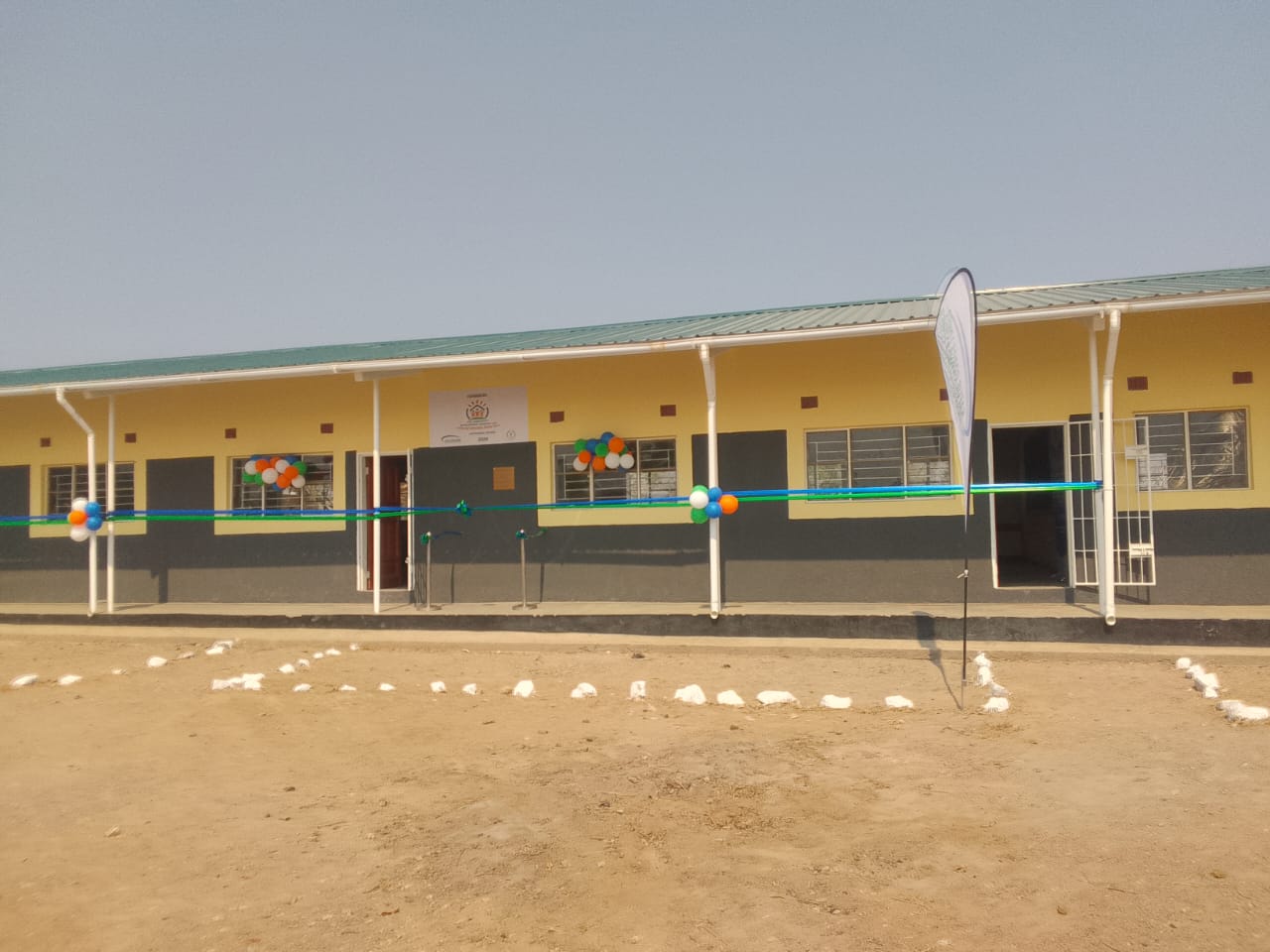
Kafue Gorge Lower Community Development Company (KGL CDC) has injected a combined total of K51 million in community infrastructure, including a classroom block, solar powered water system and a staff house at Kacholola Primary School in Chief Naluama’s Chiefdom, Chikankata district, Southern Province, to improve access to essential services and support long-term development.
The company has also handed over the completed ablution blocks and water supply upgrade at Kaabo Secondary School, where a hand pump has been replaced with a solar-powered water scheme with a kiosk.
At Shamatuli village, the solar-powered borehole for irrigation will support agricultural production and provide an opportunity for the community to strengthen its livelihoods. T
The projects also include Siam Ikobo dam, constructed at a cost of approximately K17.44 million and Naluama dam, at a cost of k20.6 million, representing approximately K38 million of the total investment,
Speaking during the handover of the completed projects, Ministry of Energy Permanent Secretary-Electricity, Eng. Arnold Simwaba said community development projects undertaken by KGLCDC will help improve education, agricultural productivity and access to essential services in Chikankata district.
Eng. Simwaba, who was represented by Ministry’s Director of Planning and Information, Sineva Kambenja, stated that the projects were timely as Government advances the Grow Zambia agenda, which seeks to translate economic stability into tangible improvements in people’s livelihoods.
He added that the investments in school infrastructure, water supply, sanitation and electricity would complement Government’s free education policy by ensuring that increased school enrolment is matched with improved learning conditions. “We must now continue to ensure that when these children enter the classroom, they find an environment that supports meaningful learning,” he said.
At the same event, ZESCO Limited Managing Director and Board Chairperson of Kafue Gorge Lower Power Development Corporation Justin Loongo, said the projects had been identified in consultation with communities to address their specific needs. “These projects are part of our continuing responsibility to the people who helped make these investments possible,” he said.
Eng. Loongo, who was represented by ZESCO Director Planning Wesley Lwindi, stated that KGLCDC would continue engaging traditional leaders, communities and relevant government institutions to identify needs, agree on priorities and coordinate development initiatives. “We complement work being done by government through the Constituency Development Fund, so that the activities we undertake do not run parallel, but complement each other,” he said, urging beneficiaries and relevant authorities to ensure the facilities are effectively utilized and properly maintained.
At the same event, KGL Chief Executive Officer, Eng. Manaku Malozo, stated that the investment reflected the company’s continued partnership with host communities and its commitment to ensuring that they benefit from energy development.
Eng. Malozo emphasized the need for proper management and maintenance of the infrastructure to ensure its long-term benefits, urging responsible authorities and community leaders to establish clear arrangements for the operation and maintenance of the dams, school facilities, electrical installations and water systems. “Their completion must now be followed by effective management so that they can support community needs over the long term,” he emphasized.
Meanwhile, KGLCDC General Manager, Aden Nkandela said the company has prioritized education, water and sanitation, agriculture and electrification in its community development initiatives in Naluama Chiefdom.
Mr. Nkandela explained that the interventions were informed by community needs, with a baseline study showing school dropout rates of about 80 percent in most remote areas and 79 percent of communities experiencing seasonal and unreliable water supplies.
He said KGLCDC had completed a classroom block, staff house, ablution facilities and a solar-powered water scheme at Kacholola Primary School at a cost of K2.9 million, benefiting approximately 3,900 learners, and also provided ablution facilities at Kaabo Secondary School, benefiting 476 learners, and introduced a solar-powered water scheme and kiosk benefiting 1,191 learners.
“ In addition, solar-powered agricultural facilities habe been established to support cooperative members and households in Shamatuli and Miyawara communities, at a cost of K769,234,” he added.