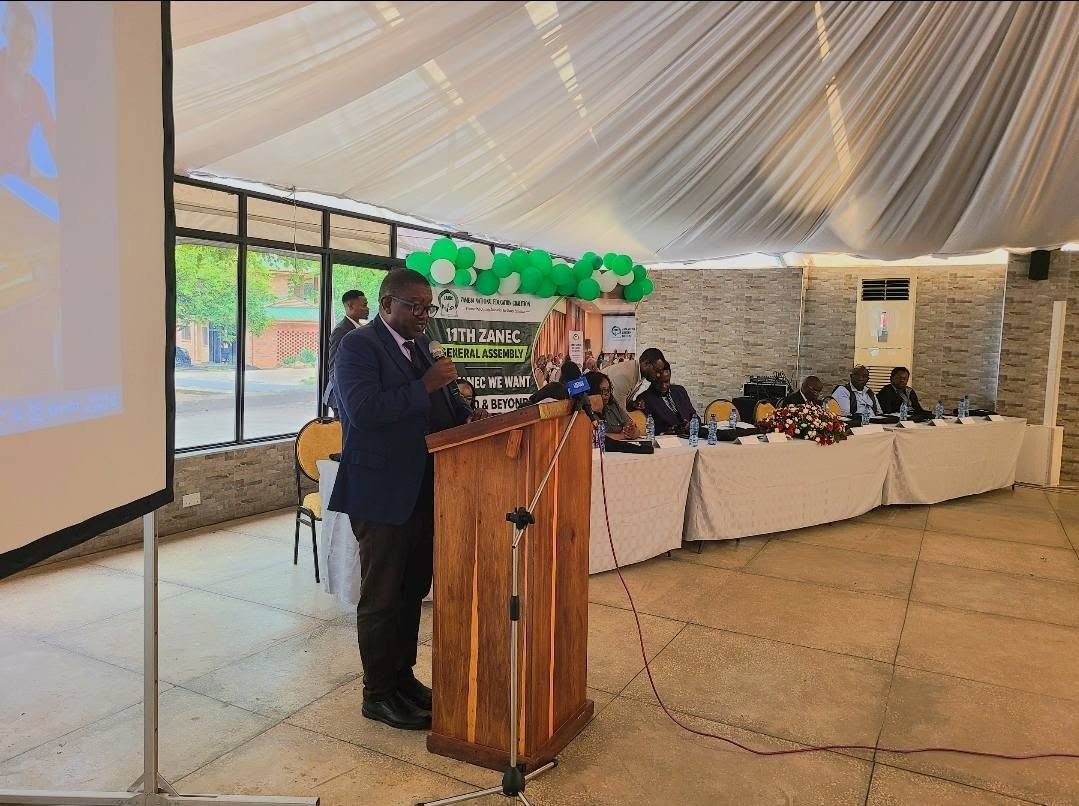
Minister of Education has urged the Zambia National Education Coalition (ZANEC) to establish clear priorities, realistic action plans and measurable targets to strengthen its contribution to the education sector by 2030 and beyond.
Officiating at the Coalition’s 11th General Assembly in Lusaka held under the theme: “the ZANEC we want by 2030 and beyond”, Harry Kamboni said achieving equitable and quality education for all requires collective efforts from Government, civil society and other stakeholders.
“Government cannot and should not work alone to address the complex challenges facing our education system. Education is a shared responsibility,” he said.
Mr. Kamboni, who was represented by the Ministry’s Director of Primary Education, Felix Ng’oma, stated that the coalition had an important role to play in connecting Government with communities through research, advocacy, monitoring and policy dialogue.
He noted that since its establishment 23 years ago, ZANEC had provided a platform for non-state actors to contribute to the education and skills sector, adding that its diverse membership was a significant strength that should be harnessed around shared priorities.
The Minister acknowledged the progress made in expanding access to education, particularly following the introduction of the free education policy, which has seen more than 2 million learners return to school, but stressed that increased access must be accompanied by quality, equity and relevance in learning.
He highlighted Government’s efforts to deploy more teachers to rural and remote areas, provide teaching and learning materials for the implementation of the competency-based curriculum and expand the school feeding programme to reach more than 4.6 million learners nationwide.
Mr. Kamboni further challenged ZANEC to remain independent, accountable and resilient while strengthening citizen participation, promoting inclusive education and advocating sustainable education financing, urging the coalition to ensure that its deliberations translate into practical actions and measurable outcomes that improve learning for learners across the country.
And ZANEC Board Chairperson, Henry Kabwes, urged government to provide adequate and predictable education financing, with increased investment in teacher recruitment and development, learning materials, school infrastructure and inclusive education.
Mr. Kabwe also called for effective implementation of the 2023 curriculum reforms, noting that teachers must be adequately supported with appropriate learning materials and sufficient resources to deliver the intended outcomes.
“Effective implementation requires supported teachers, appropriate materials, sufficient resources, and regular monitoring,” he said.
Mr. Kabwe further emphasized the need for continuous engagement between stakeholders and government to monitor the implementation of education policies and strengthen accountability, adding that ZANEC would continue using evidence-based advocacy and community voices to ensure that education reforms translate into meaningful improvements.
“ZANEC will continue engaging government and using evidence and community voices to monitor implementation and strengthen accountability,” Mr. Kabwe added.
Meanwhile, Norwegian Students’ and Academics’ International Assistance Fund (SAIH) Programme Advisor-Southern Africa, Liberty Matsive, called for stronger collaboration between civil society organizations and Government to promote equitable and inclusive access to education in Zambia.
He said education financing should not become a barrier to access, but should instead address existing inequalities and ensure that all learners have equal opportunities regardless of their economic backgrounds. “We believe that education financing should never become a barrier to preventing access. Financing mechanisms should instead help address existing inequalities,”he stated.
Mr. Matsive also urged ZANEC to strengthen its governance, accountability and institutional sustainability while developing innovative approaches to addressing challenges in the education sector.