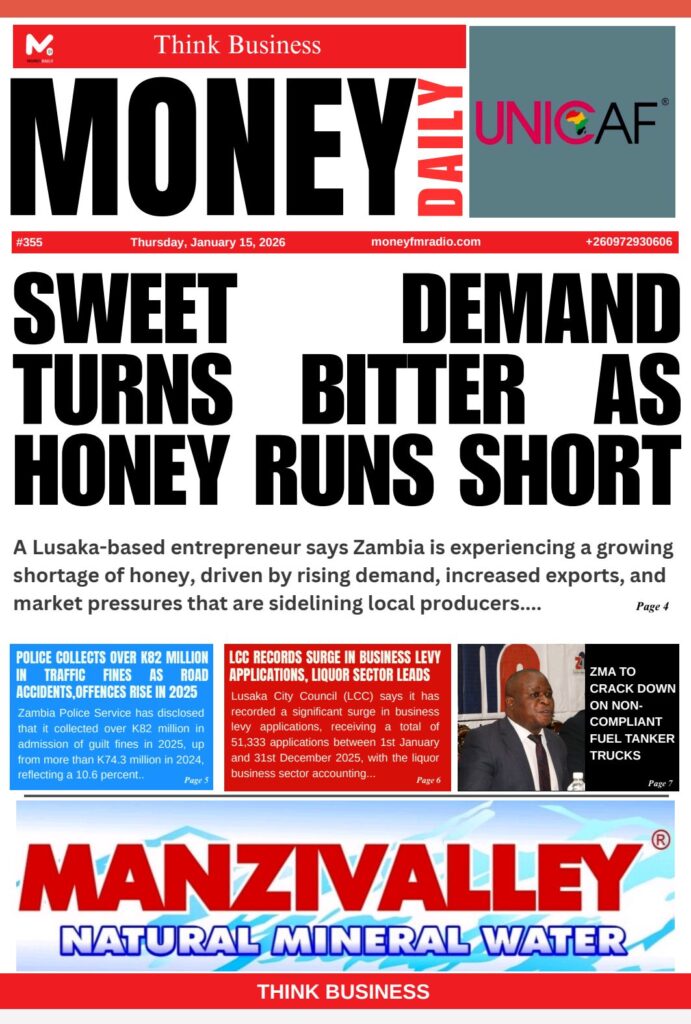

A Lusaka-based entrepreneur says Zambia is experiencing a growing shortage of honey, driven by rising demand, increased exports, and market pressures that are sidelining local producers.
Speaking in an interview with Money News, Joe Billy Mwinkeu noted that demand for honey has surged sharply as more consumers turn to natural alternatives to sugar in pursuit of better health.
Mr. Mwinkeu stated that health-conscious consumers are increasingly choosing honey for its perceived nutritional and anti-aging benefits, making it one of the fastest-growing natural products on the local market.
He observed that the demand for honey is now very high, largely because people have become more aware of the negative health effects associated with excessive sugar consumption.
“The current market demand for honey in Zambia is 100% high because people now have come to the realization that they need to take honey in place of sugar. Sugar is causing so many problems to their bodies and it is weakening them and honey is the strength that they definitely need in order for them to survive and become unstoppable. So the market demand is people who are very much aware of their health and they want to make sure they have good health,” he said.
Mr. Mwinkeu stated that this strong demand has not been matched by sufficient local supply, leading to shortages in many parts of the country.
He attributed the honey shortage to a combination of limited production capacity and intensified competition, particularly from foreign buyers and investors who are active in honey-producing regions such as North-Western Province.
Mr. Mwinkeu explained that these buyers often offer higher prices to producers, driving up market prices and making it difficult for local entrepreneurs with limited capital to compete.
He further claimed that increased exports and alleged smuggling of honey have reduced the volumes available on the local market, while small-scale Zambian traders are being pushed out due to their inability to match the prices offered by well-capitalized buyers.
“The shortage of honey in Zambia is because number one; there are a lot of foreigners that have come in this industry and they are taking away these opportunities that are supposed to be for the locals to expand and be empowered. And so the shortage of honey is because people are doing a lot of exports.”
“I am very happy to see Zambians are doing exports, but the problem is, it is not only Zambians, it has now become a thing whereby this market has been given to even foreigners who are not Zambians and they are just coming in. They get into what I would say smuggling. They get into the fields because now they know honey is coming from Northwestern Province,” Mr. Mwinkeu asserted.
Mr. Mwinkeu called on the government to strengthen oversight of the honey sector by closely monitoring who is operating in the market and ensuring that local producers and traders are protected.
He also appealed for greater empowerment of Zambian entrepreneurs, particularly young people, through access to financing and business support.
He believes that with adequate capital and a supportive trading environment, local honey producers would be able to scale up production and supply large retail chains which require consistent volumes.