

Zambia, in collaboration with the World Bank has officially opened the Second Lobito Corridor Coordination Meeting with Angola, the Democratic Republic of Congo, development partners and private-sector stakeholders to accelerate coordinated implementation of one of Africa’s major emerging trade and investment corridors.
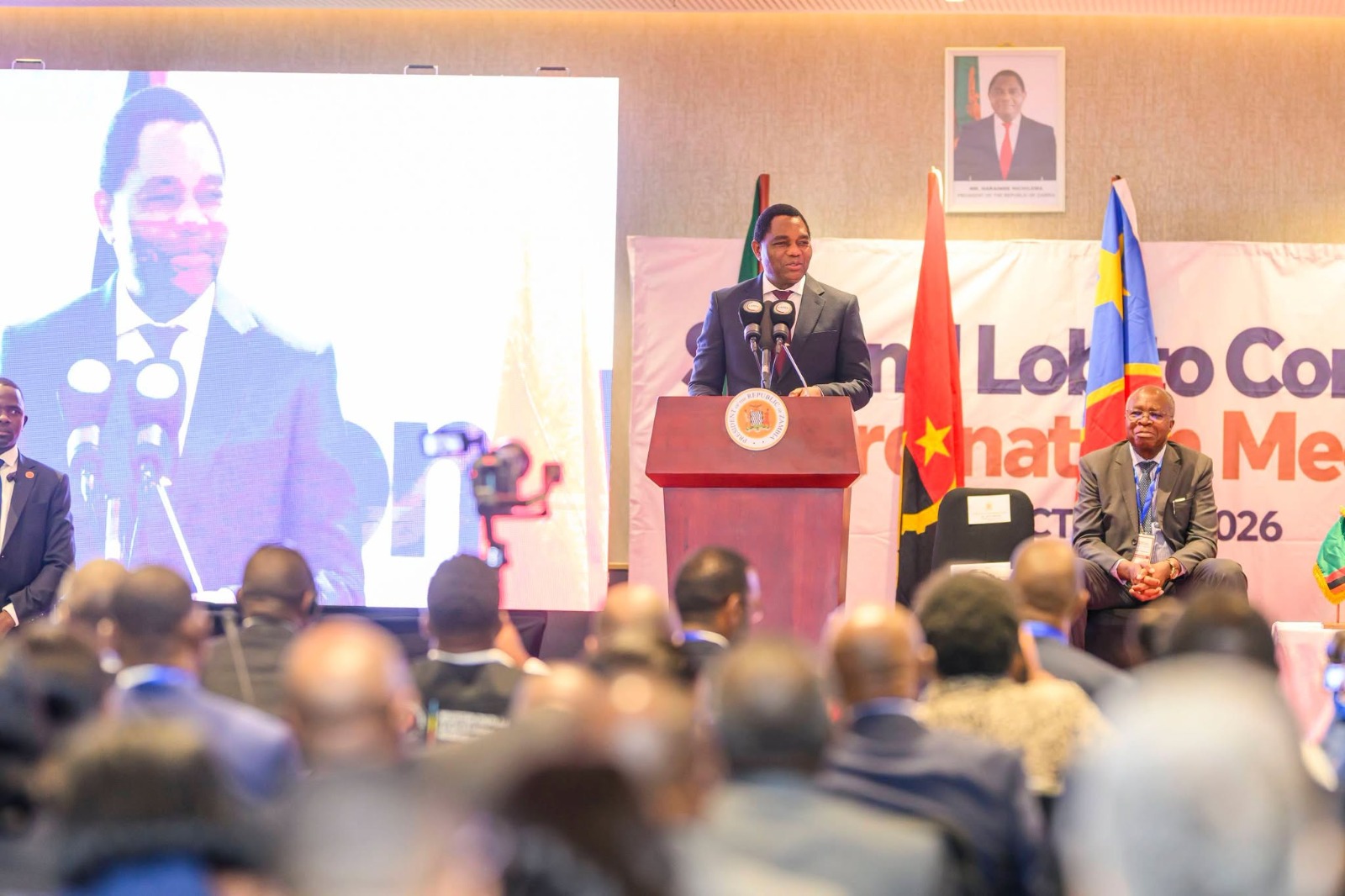
The meeting which will run from 5th to 6th October 2026, will provide the country with an opportunity to connect macroeconomic reform with the infrastructure, trade facilitation, private capital, and regional integration required to unlock Zambia’s productive potential.
Officiating at the meeting, President Hakainde Hichilema said Zambia’s goal is to turn commitments into investment, stronger regional trade and jobs by improving connectivity and lowering transport costs. “Zambia remains committed to ensuring this partnership delivers tangible benefits for our people and advances the Grow Zambia Agenda,” President Hichilema said.
At the same event, Minister of Finance and National Planning Dr. Situmbeko Musokotwane called for concrete action to accelerate the development of the Lobito Economic Corridor.
Dr. Musokotwane said the three governments of Zambia, Angola and the DRC, together with development partners, have made several pronouncements on the corridor, but progress on the ground has been limited.
“Our first and inaugural coordination meeting was held in Luanda, Angola on 5th February 2026. It is our expectation that through the Second coordination meeting being held here in Lusaka, we will move a step further in terms of making concrete decisions,” he said. “The Corridor will not move forward by words alone, but by actions and working together to achieve our shared goals.”
He stated that the viability of the rail line would depend on increased production of copper, other minerals and agricultural products, alongside investment in roads, warehouses and other logistical services.
Dr. Musokotwane added that Zambia believes development should be private-sector-led, hence the need to involve businesses from the planning stage.
Meanwhile, World Bank Managing Director, Anna Bjerde said the success of the Lobito Corridor will depend on its ability to generate economic benefits for communities across Angola, the Democratic Republic of Congo and Zambia.
Ms. Bjerde stated that while significant progress has been made since the inaugural Lobito Corridor Coordination Meeting eight months ago, more work is needed to unlock the corridor’s full potential.
“The success of Lobito Corridor will be judged not by the volume of freight it moves – although that it critical for its viability – but by its ability to generate national, regional and local benefits at scale,” she said.
She stressed that Zambia and the DRC together supply more than 17 percent of the world’s copper and over 70 percent of its cobalt, while Angola provides an Atlantic gateway to international markets.
“Through existing competing routes, a shipment can take up to twenty-eight days from mine to port. Through a well-functioning Lobito Corridor, that journey could instead be around five,” Ms. Bjerde added.
She said efficient and affordable logistics would make it possible for the three countries to expand processing, refining and manufacturing along the corridor instead of exporting raw materials.
Ms. Bjerde noted that by 2030, an additional eight to ten million people would have entered working age across Angola, the DRC and Zambia, increasing the need for the corridor to generate jobs and economic opportunities.
For Zambia, the Lobito Corridor is more than a transport route and represents an economic development and investment platform capable of connecting productive sectors to regional and global markets, reducing trade and logistics constraints, and mobilizing capital into mining, agriculture, energy, manufacturing, logistics, and other value chains.
