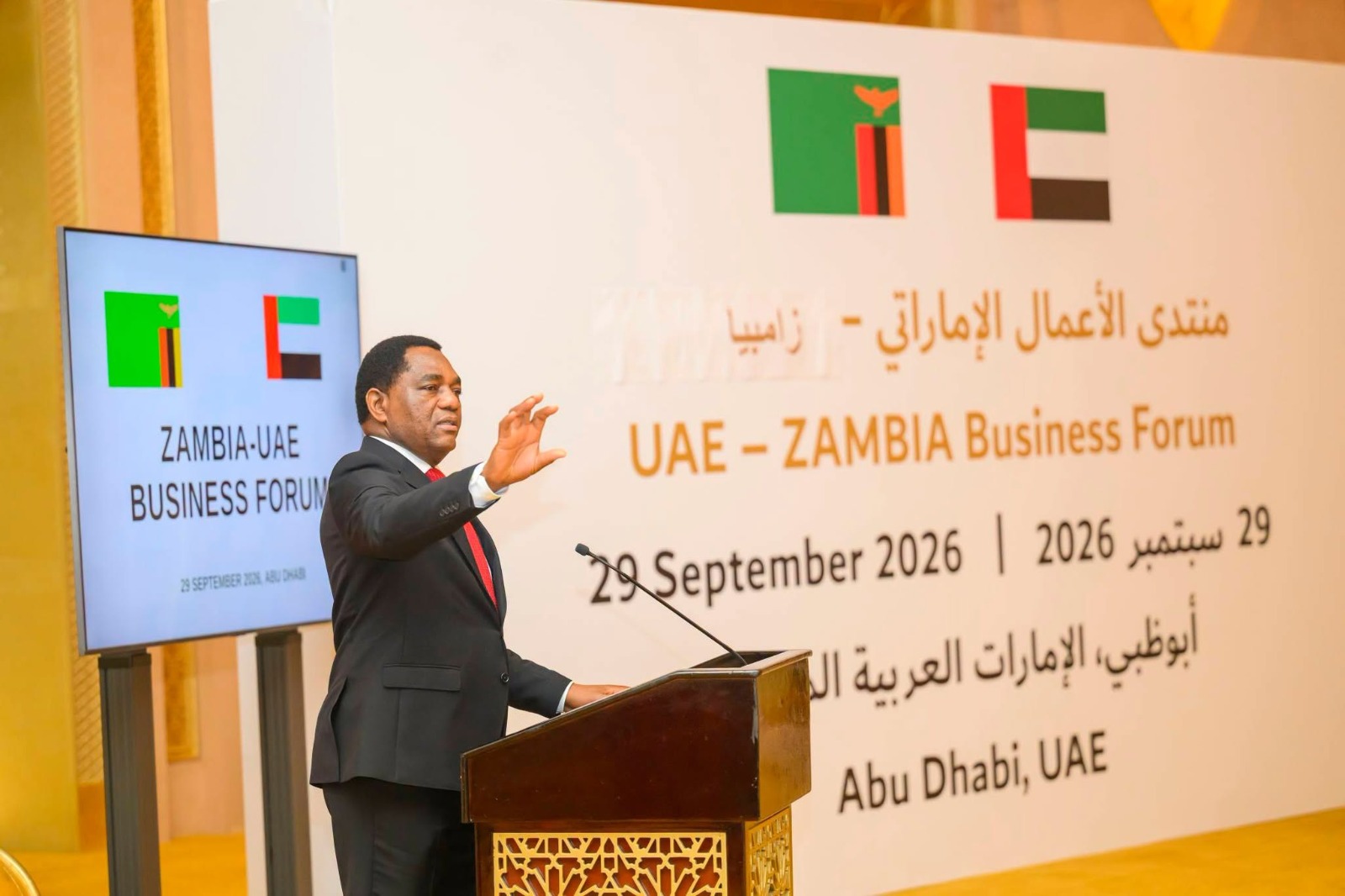
Zambia and the United Arab Emirates (UAE) have signed Memoranda of Understanding (MoUs) on various economic cooperation between the two countries, worth US$2.14 billion.
President Hakainde Hichilema, who is currently undertaking a two-day-working visit in Abu Dhabi, focused on strengthening international partnerships and attracting investment to Zambia, said the country looks forward to signing the Comprehensive Partnership Agreement with the UAE, to increase trade between the two nations.
“We will continue to prioritize increased trade and domestic reforms to attract the investment needed to grow our economy,” he said.
According to a Facebook post monitored by Money News, President Hichilema expressed gratitude to UAE President Sheikh Mohamed bin Zayed Al Nahyan, for the invitation. “Zambia remains open and ready for business and investment,” President Hichilema stated.
Meanwhile, the Head of State called for increased value addition and beneficiation of Zambia’s natural resources as the country seeks to attract more investment and maximize economic benefits from its resources.
Speaking at the Zambia-UAE Business Forum in Abu Dhabi, President Hichilema said Zambia recognizes the limitations in its capacity to process all the minerals it produces, but wants to work with investors to gradually build value-addition capacity.
He stressed that Zambia cannot consume all the copper it produces through local value addition and must therefore adopt practical approaches that allow the mineral to reach markets while the country develops the capacity to process more of it locally.
“We would like to see more beneficiation, more value addition,” President Hichilema stressed.
The President also encouraged investors to consider opportunities beyond mining, particularly in energy infrastructure, saying Zambia needs investment in transmission and distribution networks to move electricity from generation points to areas of demand.
He said the country was looking at opportunities linked to about 10,000 megawatts of generation capacity, but had not yet fully developed the infrastructure needed to transmit the power to consumers.
President Hichilema added that government was also open to working with the private sector where Zambia currently lacks sufficient processing capacity, including arrangements that would allow exports to continue while local capacity is being developed.
He said such arrangements should be implemented efficiently to avoid delays that could affect jobs, investment and the country’s contribution to the economy.
“We work with industry to automatically issue the export exports automatic injected by if you like triggered by the situation,” he added.
The President further highlighted the importance of partnerships between government and the private sector, noting that collaboration was necessary for creating an operating environment where appropriate business decisions could be made.