By Cecilia Chiluba
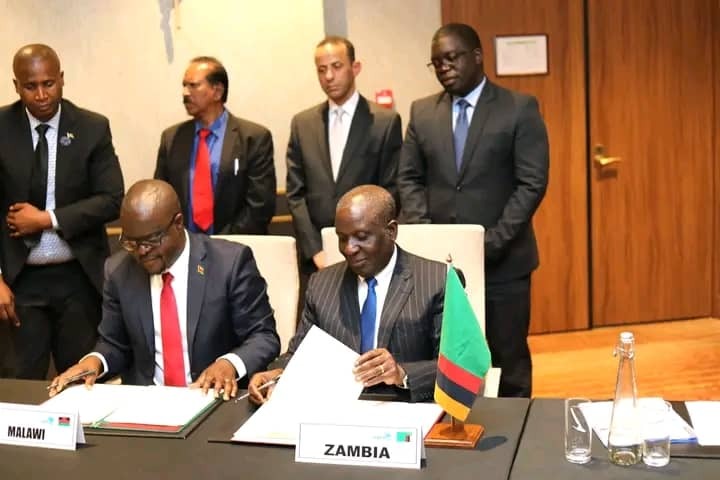
In a groundbreaking stride toward regional integration and economic empowerment, Zambia and Malawi recently signed the first-ever Mutual Recognition Agreement (MRA) on conformity assessment for six agricultural commodities—ushering in a new era of cross-border trade within the Common Market for Eastern and Southern Africa (COMESA).
The Agreement is set to revolutionize agricultural trade between the two nations, promising increased trade volumes, better market access for farmers, and improved incomes.
The historic pact, signed in Lusaka on 11th August, 2025, is poised to dismantle long-standing technical barriers and fast-track trade for six staple crops including maize, groundnuts, beans, rice, soybeans, and sorghum, across key COMESA nations, including Kenya, Rwanda, Uganda, Zimbabwe, Malawi, and Zambia.
At the heart of this initiative is COMESA’s renewed call to unlock the region’s untapped trade potential.
Despite comprising 21 member states and a combined trade potential of over US$100 billion, intra- COMESA trade currently lags behind at just US$14 billion, a meager less than 20%.
Officiating at the event, Zambia’s Agriculture Minister Reuben Mtolo noted that key benefits of the Agreement include enhanced trade cooperation, sanitary and phytosanitary standards, reduced trade barriers, increased market access, and efficient trade processes among others.
“The Agreement we are signing today is a product of the profound and dedicated facilitation of COMESA. This Agreement is more than just a document, it is a symbol of shared vision and commitment.”
“By harmonizing our standards and strengthening sanitary and phytosanitary measures, we are paving the way for safer, faster, and more efficient trade between our two nations,” Mr. Mtolo added.
The MRA is backed by strategic development partners such as the Alliance for a Green Revolution in Africa (AGRA) and the United Kingdom’s Foreign, Commonwealth & Development Office (FCDO). The UK Government has injected £1 million into the initiative, as part of the broader £35 million Africa Food Trade and Resilience Programme, which AGRA has implemented over the past six years.
And Malawi’s Minister of Trade and Industry, Vitumbiko Mumba, hailed the Agreement as a concrete solution to challenges that have long stifled regional exporters, farmers, and traders.
“This Agreement is more than trade facilitation, it is about strengthening trust in our national quality institutions, it is about building mutual confidence in standards and regulatory frameworks in our two great nations,” he said.
COMESA Acting Secretary General Dr. Mohamed Kadah emphasized that the Malawi-Zambia MRA sets a precedent for regional cooperation.
“This agreement is expected to increase trade between the two countries, enhancing economic growth and development.This signing exemplifies our commitment to seamless trade. But more importantly, we must ensure that the benefits trickle down to our farmers, entrepreneurs, and SMEs who form the backbone of our economies,” he emphasized.
The United Kingdom’s High Commissioner to Zambia, Rebecca Terzeon, said as the first MRA of its kind, the initiative will encourage other countries to follow suit, enabling the movement of tradable food samples across borders.
She applauded the Agreement as a trailblazer in transforming Africa’s food systems. “With demand for food in Africa expected to triple by 2050, facilitating cross-border movement of food is no longer a luxury—it is a necessity,” she said.
Further, AGRA President Alice Ruhweza, represented by Dr. Daniel Njiwa, Director of Inclusive Markets, Trade and Finance, warned of the continent’s growing reliance on food imports, which currently stands at US$100 billion annually, much of which includes products that Africa has the capacity to produce itself.
“We must reverse this trend,” she urged. “By enabling countries like Zambia and Malawi to trade with each other more efficiently, this Agreement helps build Africa’s food sovereignty.”
And in an exclusive interview with Money News, Agriculture Climate Action Foundation (ACAF), a Zambian organization focused on promoting sustainable agriculture and climate resilience, commended the initiative, highlighting its critical role in enhancing Zambia’s agricultural sector and addressing long-standing market challenges.
ACAF Executive Director Dr. Oliver Bulaya observed that for some time, Zambia has faced difficulties in securing markets for its agricultural produce, therefore, the MRA is seen as a pivotal step towards establishing crucial regional market linkages.
“By harmonizing grading standards and eliminating technical barriers, Zambian farmers and exporters may find it easier to access Malawian markets and this can potentially lead to better prices for their products and increased incomes,” he added.
The Zambia–Malawi MRA is the first of several planned agreements under the COMESA Mutual Recognition framework. Upcoming MRAs are in the pipeline for Kenya–Uganda, Malawi–Zimbabwe, and Zambia–Zimbabwe—collectively designed to transform the landscape of agricultural trade across Eastern and Southern Africa.
However, the success of the programme hinges on effective cooperation and communication between countries and their respective authorities, with any delays or inefficiencies risking the undermining of its potential benefits.
Furthermore, ongoing assessment of the MRA’s impact on trade flows and agricultural productivity is crucial to ensure that the benefits are equitably distributed among all stakeholders.
The signing of the MRA is part of COMESA’s broader regional integration agenda aimed at deepening economic integration, expanding intra-regional trade, and promoting inclusive development among its 21 member states.
These efforts are driven through key pillars such as market integration, improved physical connectivity, productive integration, as well as gender and social inclusion, with flagship initiatives including the COMESA Free Trade Area (FTA), the Trade Facilitation Regional Programme, monetary harmonization, and capacity-building programmes.