President Hakainde Hichilema has emphasized the need for deeper regional integration in energy, describing regional power pools as essential building blocks toward a single electricity market for Africa under the African Continental Free Trade Area (AfCFTA).
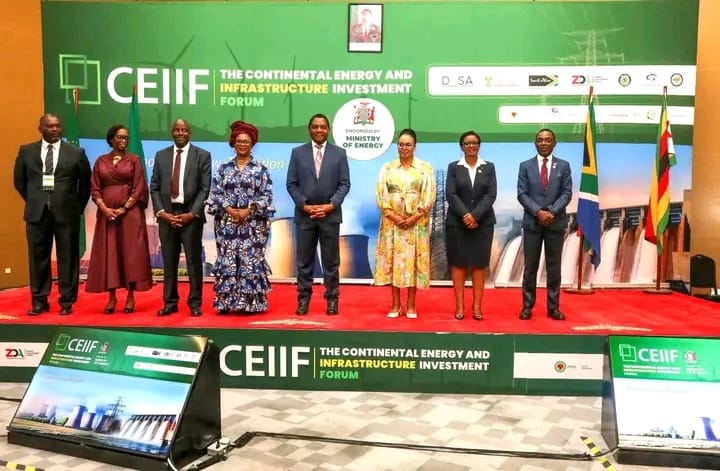
Officiating at the Continental Energy and Infrastructure Investment Forum (CEIIF) in Lusaka, President Hichilema said regional economic blocs such as SADC, the East African Community and ECOWAS have already built experience in cross-border cooperation that should now be scaled up continent-wide.
“A single electricity market for Africa will not come from theory alone, it will come from practical cooperation, shared infrastructure and coordinated investments across regions,” he said.
President Hichilema also called on Africa to urgently close the gap between policy discussions and real delivery particularly in the energy sector, noting that the continent’s biggest challenge is not lack of ideas but weak and delayed implementation.
The President noted that Africa has held enough well-articulated conversations and must now focus on expeditious and effective implementation.
“Africa’s problem is not ideas. Africa’s problem is getting things done. We discuss technical solutions, but our efforts evaporate at the point of implementation. That gap must be deliberately addressed,” President Hichilema added.
President Hichilema also expressed concern at what he described as misguided risk profiling of Africa, which inflates the cost of capital for African projects and economies.
The Head of State noted that African projects often deliver competitive returns, disputing the narrative that Africa inherently produces lower yields.
To address this, President Hichilema proposed the creation of African-based credit rating and financial institutions, so that the continent can assess and profile its own risks rather than relying entirely on external agencies.
He reaffirmed Zambia’s commitment to joint investments in energy and infrastructure, saying the country stands with other African states in accelerating bankable projects.
And Energy Minister Makozo Chikote said Zambia plans to expand national generation capacity from 3.7 gigawatts in 2023 to 10 gigawatts by 2030, with solar and other renewables playing a central role.
Mr. Chikote stated that the share of renewable energy in the power mix is expected to rise from about 5 percent to 33 percent over the same period.
“Beyond generation, the government is prioritising interconnectivity to move power efficiently across the country and beyond its borders. High-voltage transmission lines are set to expand from about 12,700 kilometres to nearly 18,000 kilometres by 2030, enabling electricity to flow from new solar projects to farms, mines, industries and export markets,” Mr. Chikote said.
At the same event, African Union (AU) Commissioner for Infrastructure and Energy, Lerato Mataboge revealed that about 600 million Africans still live without electricity, calling it not merely an access gap but a structural barrier to development.
Ms. Mataboge said this reality is why energy has been elevated to the centre of the African Union’s Agenda 2063.
“Energy is no longer a sectoral issue, it is the backbone of Africa’s integration, industrialisation, digitalisation and human development,” she said.
She outlined progress on the African Single Electricity Market (AfSEM), which aims to connect the continent’s five regional power pools into a single market.