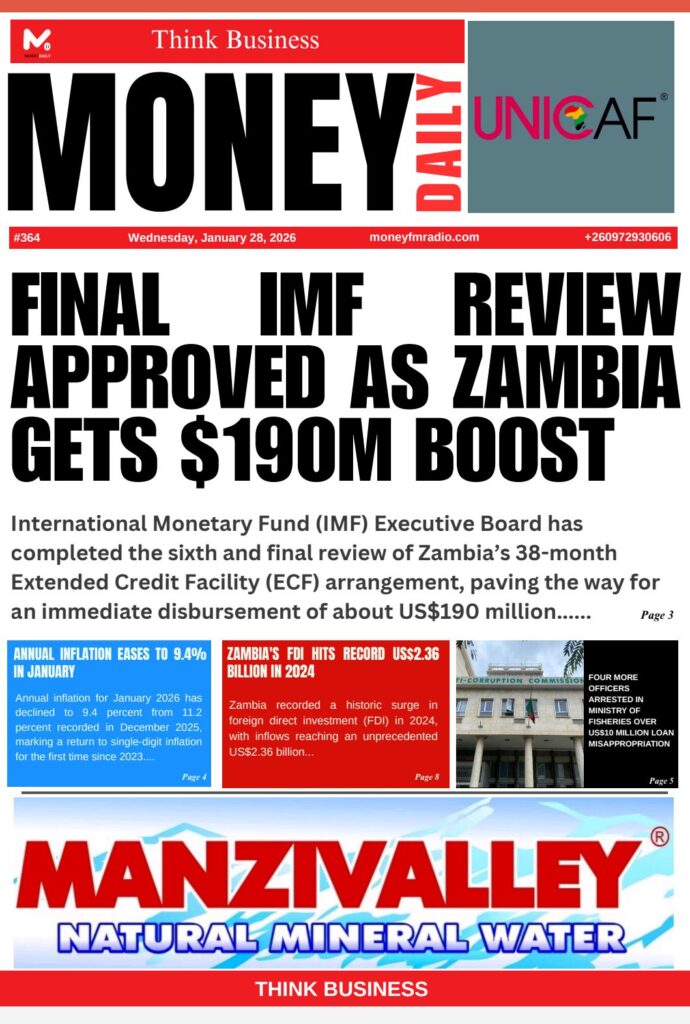

International Monetary Fund (IMF) Executive Board has completed the sixth and final review of Zambia’s 38-month Extended Credit Facility (ECF) arrangement, paving the way for an immediate disbursement of about US$190 million.
The ECF programme was approved on August 31, 2022, and with the latest release, Zambia’s total disbursements under the IMF-supported initiative rise to approximately US$1.7 billion.
The facility has supported Zambia’s reform agenda aimed at restoring macroeconomic stability, building economic resilience, as well as promoting sustainable and inclusive growth.
In a statement issued following the Board meeting, IMF Deputy Managing Director and Acting Chair, Nigel Clarke, said programme performance had been broadly satisfactory, despite some delays in meeting structural reform benchmarks.
Mr. Clarke stated that all end-June 2025 quantitative performance criteria and indicative targets were met, except for those related to net international reserves and the clearance of spending arrears.
He said the Board granted a waiver for the non-observance of the net international reserves target. “Eight out of 19 structural benchmarks (SBs) were met, and six additional SBs were completed with delays,” he noted.
Mr. Clarke further noted that Zambia’s economic outlook remains positive, with Real Gross Domestic Product (GDP) growth estimated at 5.2 percent in 2025, driven by strong mining activity and record-high maize production.
“Real GDP growth in 2026 is projected at 5.8 percent on the back of continued recovery in electricity generation and strong performance in mining and services. Inflation is projected to converge gradually toward the 6-8 percent target band by 2027,” Mr. Clarke added.
While global economic uncertainty persists, he said Zambia’s medium-term outlook remains favorable, contingent on scaling up mining investment, sustaining agricultural output, improving power generation, and maintaining fiscal discipline.
Mr. Clarke however, cautioned that Zambia’s public debt, though assessed as sustainable, remains at high risk of both overall and external debt distress.
He observed that progress has been made on debt restructuring, with five bilateral agreements signed with official creditors, while negotiations with commercial creditors are advancing.
Mr. Clarke emphasized that adherence to the planned fiscal consolidation path could help lower the risk of external debt distress to a moderate level over the medium term.
He further observed that Zambia has made significant strides in reducing macroeconomic imbalances and advancing debt restructuring despite facing both domestic and external shocks.
“Despite external and domestic shocks, Zambia has significantly reduced macroeconomic imbalances, made considerable progress on debt restructuring, and undertaken sustained fiscal consolidation while safeguarding social spending,” he said.
“The performance under the program has been broadly satisfactory and the authorities should remain focused on maintaining prudent macroeconomic policies and advancing reforms to foster inclusive and private-sector-led growth.”
He added that careful calibration of monetary policy would be critical to anchoring inflation expectations and preserving price stability, while rebuilding international reserves and maintaining exchange rate flexibility would strengthen resilience to external shocks.