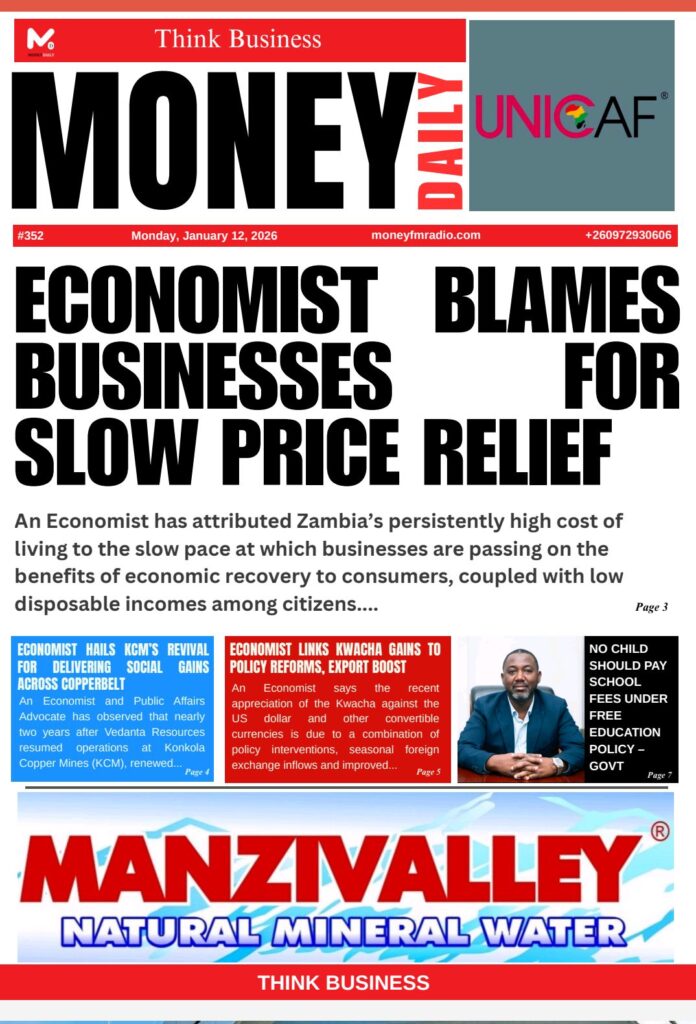

An Economist has attributed Zambia’s persistently high cost of living to the slow pace at which businesses are passing on the benefits of economic recovery to consumers, coupled with low disposable incomes among citizens.
Speaking in an interview with Money News, Partner Siabutuba stated that despite positive macroeconomic indicators such as declining inflation, a relatively stable Kwacha against major convertible currencies, and signs of economic recovery, prices of goods and services have not adjusted significantly to ease pressure on households.
Mr. Siabutuba noted that President Hakainde Hichilema had previously appealed to manufacturers to transfer the benefits of economic recovery to citizens by reducing prices of goods and services.
He observed that while some companies have made efforts to reduce prices, the overall response from manufacturers and service providers has been slow.
“I think there are two parameters, really, that you could consider for the reasons why cost of living still remains high. Number one is that there is a weak movement by service and goods providers to share the benefits of the economic progress we are making as a country.”
“So the biggest thing, really, is the slow pace by which companies and manufacturers, are transferring benefits to the citizens. In other countries, you would have seen a government moving in to control prices, but because we are in a free economy, you cannot move in to control prices,” Mr. Siabutuba stated.
He further explained that even where prices have marginally declined, citizens’ ability to afford basic goods remains constrained due to low incomes.
“So number two, even when some of these parameters remain positive, the income side of citizens to be able to afford is still a challenge, because you can have cheaper things on the market, but your capacity as an individual to afford still remains undermined. So the disposable income levels of citizens is still very low.”
“And so this is why, even when you could have observed a reduction in the cost of meal meal, for example, there are very few people that can still find that meal meal cheap. So it still remains expensive because their disposable income levels are still low. So that is one of the biggest parameters,” Mr. Siabutuba added.
Mr. Siabutuba stressed the need for broader discussions on improving wages and reviewing taxes and statutory deductions that reduce take-home pay for employed citizens.
He stressed that enhancing disposable incomes would strengthen citizens’ spending capacity and help ease the cost-of-living burden.
“So we need to also be talking about how can we ensure that citizens have better pay and we have enough disposable income. We need a conversation around some of the taxes, some of the obligations you and me, who are employed, are supposed to have. So that then we have enough income that can remain at our disposal to spend,” he stressed.
Mr. Siabutuba said until incomes rise alongside economic growth, many Zambians will continue to experience high living costs despite improvements in the overall economic outlook.